
BMW E92 M3 misfire traced to a broken valve spring
john_s reported an immediate bank-one misfire on his 2008 E92 M3. A zero-compression result on cylinder 1 led to a broken valve spring; he later reported good compression and a return to daily driving after replacing it.

Select a photo to view its source post. The source may require sign-in.
Repeated misfires immediately after starting
M3Post member john_s described a daily-driven 2008 E92 M3 that entered limp mode roughly two seconds after starting. He reported cylinder 1, 2 and 3 misfire codes, a multiple-misfire code, fuel smell and a cold passenger-side exhaust. Replacing oxygen sensors, exhaust gaskets, the fuel-tank breather valve, plugs and injectors had not resolved it. Moving the coils did not make the misfire follow them. The fault began the day after a battery-cable recall visit, but the thread does not establish that the recall caused it.
Cylinder 1 had no compression
The owner reported zero compression on cylinder 1. To check his tester, he measured cylinders 2 and 3 at 180 psi and cylinder 5 at 150 psi. He explicitly noted that this was not a wide-open-throttle test, so these readings are retained as his diagnostic observations rather than reference specifications. His initial ground checks and injector observations had not identified the cause.
The spring replacement and reported return to driving
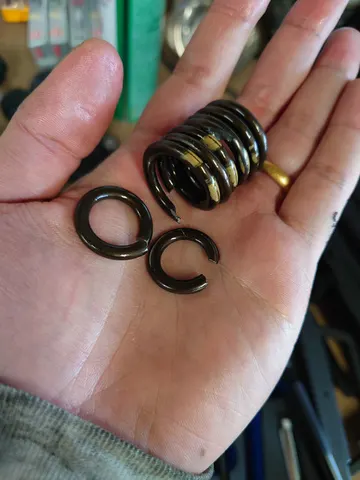
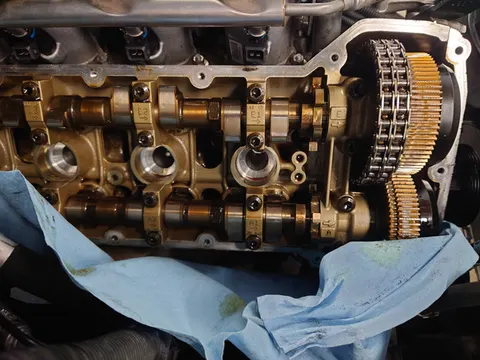
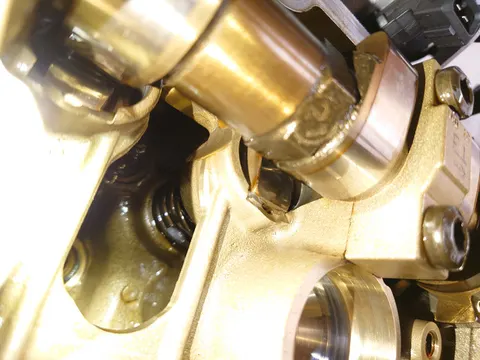
In his follow-up, john_s said a valve spring had broken into several pieces. He reported that the valve remained straight, there was no piston damage, and compression was good after he replaced the spring himself. He said the M3 was back in daily use. The three accompanying photographs belong to that repair follow-up; the condition and recovery statements remain attributed to him.
The owner’s timing-work and tool cautions
john_s stressed following ISTA rather than starting from videos or forum guides alone. He warned that inserting the crank-locking tool alone did not identify the required crank position and that the camshaft markings and the procedure’s specified position mattered. He described substantial timing work to reach the spring. He also reported difficulty using a Lisle 36050 tool, scoring the smooth guide surface for a cam follower, and finding a damaged valve-stem seal. His suggestion that the scoring was probably harmless is not a verified damage assessment. His remarks about an aftermarket timing tool are personal experience, not a compatibility or accuracy certification. He later corrected his job-difficulty rating from six to seven out of ten. This account does not supply a replacement timing procedure or torque specifications.
Similar symptoms did not always mean the same fault
fs34 described a different vehicle whose suspected valve-spring problem turned out to be a missing wiring-harness ground nut. Later, m3cole reported zero compression on cylinder 6 and a broken spring on another car, while the valve’s condition and repair outcome were still unresolved in that exchange. Those reports are separate from john_s’s cylinder-1 repair. A linked different-cause discussion was not used to infer a common defect or a failure rate.
Source reply ↗ · fs34
Source reply ↗ · m3cole
Source reply ↗ · tdott
Source reply ↗ · m3cole