
1990 Porsche 964 Carrera 4 engine reseal and top-end rebuild
RicardoD’s well-running but increasingly oily 1990 Carrera 4 led to an engine-out reseal, cylinder-head work and a long reassembly project. His choices and setbacks are documented through assembly, without establishing a post-rebuild road-test result.

Select a photo to view its source post. The source may require sign-in.
An engine-out project prompted by oil leaks
RicardoD began with a 1990 Carrera 4 showing 61,000 miles. He said it ran well, but increasing oil leakage and a dirty engine bothered him. After an earlier reseal on his separate C2, he wanted to address the C4 systematically with advice from Steve Weiner at Rennsport Systems. He initially considered modest performance changes, then moved toward keeping the car stock.
The initial leak-down readings
The author reported warm-engine leak-down readings of 3%, 10%, 5%, 14%, 5% and 14% for cylinders 1–6. He located the leakage heard at cylinders 2, 4 and 6 on the intake side and sent the results to Steve for evaluation. These were his measurements on this engine; they do not establish a universal rebuild threshold. He later explicitly said the work was not unavoidable and that having a clean, well-running engine was part of his hobby.
Removing the C4 engine
RicardoD disconnected the throttle cable at the engine after damaging a cable during earlier work on his C2. He completed the C4 removal slowly while checking for snags, then separated the transmission and placed the engine on his stand. One half-shaft caught during lowering because he had not secured it sufficiently out of the way.
A separate owner’s stand buckled
Commenter jevvy964 reported that his own apparently adequate Sealy stand buckled on the second day, although it initially held the load; he caught the engine. That is a separate incident. RicardoD’s successful use of his stand does not establish the safety of another support.
Top-end work while leaving the case closed
The author chose top-end work without splitting the crankcase. After removing the heads, cylinders and pistons, he reported small cylinder-to-head oil leaks at cylinders 1 and 2 and sent those parts to Rennsport Systems. He later said Steve had cleaned the pistons and cylinders, attended to the valves and machined for sealing rings. He also reported fitting 993TT cylinder studs and replacing the 24 case through-bolt O-rings, crankshaft seals and intermediate-shaft seal. These are the author’s reported choices for his engine, rather than a parts prescription for every 964.
Reassembly and a piston-ring setback
New cylinder-base O-rings accompanied the piston and cylinder installation. RicardoD later pushed one piston too far out and a ring came free; he obtained a ring compressor and subsequently reported all cylinders installed. After a long pause, he also reported getting the heads and cam housings assembled. His earlier quoted sealant list and later description of what he actually used differ, so the account should not be treated as a verified sealant specification or a complete assembly procedure.
A commenter’s separate gasket-damage experience
While discussing reassembly, r-mm described bending an ear of a small paper gasket on his separate 3.2 engine and having to partly lower that engine to repair it. He disagreed with part of a book’s installation approach and suggested his own alternative. That remains an attributed experience on another engine, not a confirmed failure or repair on RicardoD’s C4.
Cam timing: his measurements and limits
RicardoD checked TDC with a dedicated tool and found his mark did not sit at the center of the pulley’s Z1 notch. He reported repeatable left-bank timing, while calling the right bank close enough at that stage. He later fitted all rockers, adjusted the valves and rechecked timing. His improvised holding method and personal measurements are not a validated factory timing procedure.
His correction to the pulley and belt order
During the power-steering housing O-ring and camshaft-seal work, RicardoD explicitly corrected the DVD’s sequence: he said not to fit the large camshaft pulley last with the belt already in place. He seated and tightened the pulley first, then worked the belt around it. This is his reported correction to that demonstration, not an independently validated universal procedure.
A distributor-belt mistake caught during assembly
RicardoD found that the rotor marks did not line up after his earlier distributor-belt work. He undid the pin and gear arrangement, repeated the work and then aligned the distributor with cylinder 1 at TDC. The account records a corrected assembly mistake; it is not a measured ignition-timing result.
Refinishing and refitting the intake
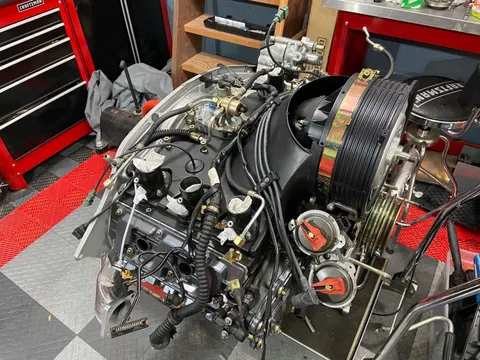
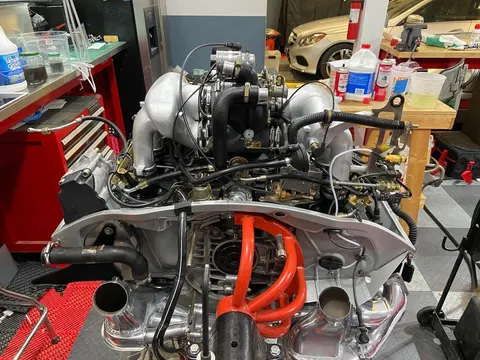
Later, RicardoD had the intake plenums Extrude Honed as an experiment. A flow increase quoted in that discussion concerned someone else’s 3.2 turbo, not a measurement on his C4. No C4 power gain is established. RicardoD described cleaning and sanding the intake before garnet blasting and applying Cerakote Glacier Silver. He explicitly left its durability to be judged years later. Subsequent photographs show assembly progress and the intake refitted to the engine. Both selected photographs show the engine outside the car on a workshop stand; they do not show the completed engine installed in the C4.
Assembly progress, without a verified long-term result
The later account includes work on the A/C compressor, belts and fan-belt sensor, while the muffler, airflow meter and air filter still remained to be fitted at that point. The documented progress does not establish a completed road test, a leak-free engine or long-term durability after the rebuild.