
2008 Porsche 997 Carrera S preventive water-pump replacement
USMC_DS1 replaced the water pump preventively on his 2008 C2S at over 52,000 miles. His account centers on tight access, a separate thermostat-housing gasket and careful reassembly; later replies add different owners’ pump-condition and access reports.

Select a photo to view its source post. The source may require sign-in.
A preventive job on the owner’s 2008 C2S
USMC_DS1 chose to replace the pump after reading other members’ failure reports and wanting to avoid a breakdown far from a Porsche dealer in the Texas summer. At the time, his 2008 C2S had over 52,000 miles and was four years old. His suggested 50,000–60,000-mile window was his preventive judgment, rather than a manufacturer service interval. He rated the job 6 out of 10 because of the components that obstruct access and the confined working space.
Access, brackets and oxygen-sensor wiring
The owner describes removing the airbox and auxiliary belt, moving the engine carrier bracket and removing the thermostat housing to reach the pump. He later identifies the wiring mentioned in the write-up as oxygen-sensor wiring and stresses freeing it from its attachment points so bracket movement does not strain it. He recommends removing the exhaust manifold for more working and torque-wrench space, although some later owners describe other access choices. His thermostat-housing torque estimate came from the effort needed to undo the screws; it is not a verified tightening specification.
“Head gasket” was corrected to exhaust-manifold gasket
The original wording caused readers to ask why a head gasket was involved. After scotsskier queried the term, USMC_DS1 explicitly corrected it to the exhaust manifold and its associated gasket. The discussion does not describe removing the cylinder head or replacing its gasket as part of this pump job.
The thermostat-housing gasket was a separate purchase
USMC_DS1 initially expected the pump gasket to supply both seals he needed. It did not fit the 997.1 thermostat housing, so he made another dealer visit for that separate gasket. He explains that the pump gasket was joined to another section by three tabs, which he cut. He only suspected that the other section was for a 996 housing; that guess is not a compatibility claim.
Pump inspection and a later change in the owner’s approach
After removal, the owner reported minor impeller wear without large pieces missing. He reassembled the car and described using an Airlift tool for refill and leak checking. In a later update at over 78,000 miles, he said the pump had been replaced three times, twice preventively, and described a shorter personal replacement approach. This does not establish three pump failures or a universal replacement interval.
A separate 103,000-mile pump and damaged stud threads
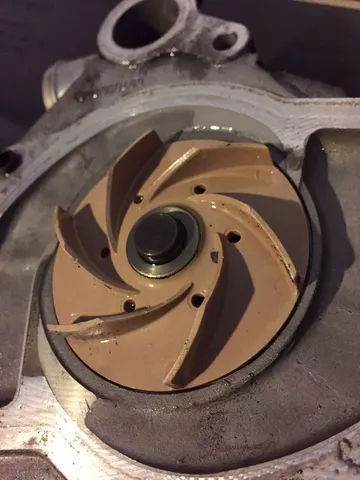
niner niner seven replaced an original pump at 103,000 miles despite reporting no warning sounds or other signs and a bearing that felt good. The photograph is from that separate car; its exact year and trim are not stated in the post. The same owner reported that support-plate studs backed out with their nuts and that gripping one stud with pliers damaged its threads, requiring thread repair. He also found moving the metal coolant line difficult; disconnecting its other hose end was a proposed improvement, not a second completed method documented in that reply.
Other owners’ access and pump findings differed
door2416 reported a 55,000-mile repair after a rattle and coolant puddle, with intact impeller fins but a failed bearing. He avoided removing the exhaust manifold because he feared snapping rusted fasteners and found access tight. In a later reply, he described removing the thermostat hose and moving nearby coolant lines, then turning the pump to work it downward. This is a separate owner’s method, not proof that exhaust removal is always required or always avoidable.