
Porsche 997.2 PDK valve-body and sensor repair
PV997’s repair research separates the 997.2 PDK valve body and sensor access from the control unit inside the car. It brings together his investigation, later contributors’ experience and the fluid-fill and calibration work discussed in the source.

Select a photo to view its source post. The source may require sign-in.
Investigating repair beyond complete replacement
Concern about complete-PDK replacement costs prompts PV997 to investigate internal components and repair options. He explicitly cautions that his research is not guaranteed to be completely accurate, and later updates incorporate work shared by other contributors. The central scope is the 997.2 PDK. Although he discusses similarities with other generations, the account does not establish compatibility across every PDK.
Separating the TCU from the valve body
The author distinguishes the hydraulic mechanism from the mechanical gearbox and describes the transmission control unit, or TCU, as a separate computer inside the vehicle. When a commenter asks whether the control module is the valve body, PV997 clarifies that the valve body is electro-mechanical and responds to TCU commands. His discussion therefore treats control-unit or software issues separately from components inside the transmission.
The valve body and individual solenoids
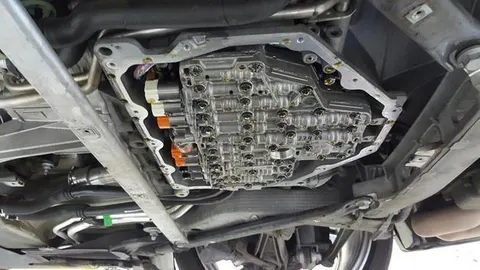
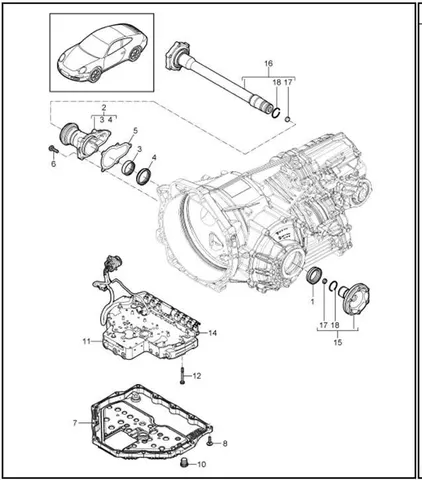
The source presents the valve body as a repair target accessible from the pan side, distinguishing that work from removing the complete transmission. Its photograph shows the exposed valve body and colored solenoid caps. PV997 investigates both replacement valve bodies and individual solenoids, while noting uncertainty about apparently similar units with different part numbers and revisions. The source’s parts discussion does not establish fitment for an individual car.
The temperature sensor and its wiring
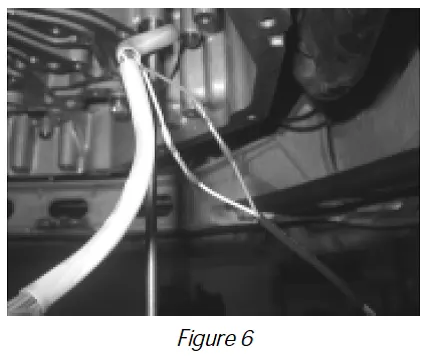
The temperature-sensor section mentions P0711 and P172D faults and an emergency-operation message, then discusses the sensor above the 997.2 valve body and a repair kit. An accompanying photograph is described as the newly connected sensor wiring. The author also proposes alternative joining methods, but does not establish personally validated results for every method. His resistance-measurement discussion explicitly notes that a normal solenoid resistance does not guarantee a healthy solenoid.
Position and speed sensors require deeper access
Gear-position and speed sensors are treated as internal gearbox work involving case separation. PV997 explains that this part of his initial research was theoretical; his 2021 revision incorporates disassembly work and photographs contributed by Damien Law, Roberto and others. He warns that cocking the case or prying at its seam can stress bearings or damage the gasket. He also states that the reassembly torque discussed there is not a confirmed factory value. This is not an established complete disassembly and reassembly procedure.
Clutch-pressure sensors and later clutch information
The clutch-pressure sensors are described as behind the clutch, with access involving transmission and clutch removal rather than the gearbox-case work used for the position sensor. The clutch discussion also evolves: after initially describing a sealed assembly, a 2023 update introduces a replacement friction-disc set and opening and rewelding the housing. These remain part of the author’s repairability research, not validation of a particular product’s quality or durability.
Fluid filling, calibration and diagnostic limits
PV997 explains the PIWIS calibration or fluid-fill work associated with valve-body replacement and related repairs. He discusses a simple fluid drain separately from repairs that remove the valve body, and distinguishes reading fault codes with Durametric from commanding the PDK. Cross-referencing fault codes with component failures remains a next step at the end of his post. The account does not establish a single-code diagnosis or a one-part remedy for every PDK problem.